How Does Artificial Intelligence Work?
AI works by converting input into numbers, processing those numbers with rules or a trained model, and returning an output such as a prediction, label, recommendation, or response.
The exact process varies by application. A spam filter, an image classifier, and a generative language model solve different problems with different architectures. At a high level, however, they all receive input, apply a computational process, and produce a result.
For machine learning systems, the most important distinction is between training and inference.
Training vs Inference
Training is the process of learning model parameters from examples; inference is the process of applying those parameters to new input.
During training, a model makes predictions on a dataset and measures how far those predictions are from the expected result. An optimisation algorithm then adjusts internal parameters to reduce the error. This cycle may run many times before the model reaches an acceptable level of performance.
Inference happens after training. When a user submits new data, the model does not normally start learning again. It uses the parameters established during training to calculate the most likely output.
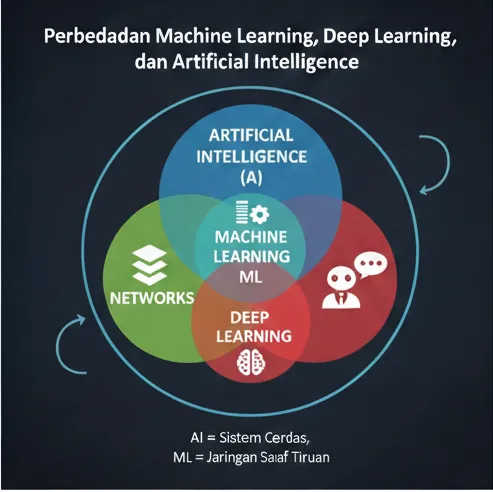
This is also why an AI model does not “know” an object in the human sense. It identifies numerical relationships that were useful across its training examples. For the broader hierarchy behind these methods, see AI vs machine learning vs deep learning.
The Five Main Stages of an AI Workflow
A typical AI workflow covers data collection, preparation, model training, inference, and post-processing. Each stage affects the quality of the final result.
1. Collecting Relevant Data
The data must match the task the model is expected to perform. Common input types include:
- Text, such as documents, support messages, or search queries.
- Images, such as product photos, scans, or satellite imagery.
- Audio, including speech, music, and environmental sounds.
- Structured data, such as transactions, sensor readings, or campaign performance.
More data is not automatically better. A demand-forecasting model needs relevant historical demand signals, not a large collection of unrelated records. Coverage and representativeness matter as much as volume.
2. Preparing the Data
Raw data usually requires cleaning and transformation. Software may remove duplicates, address missing values, standardise formats, and separate training examples from evaluation data.
The input must also become a numerical representation. Text can be divided into tokens, images represented as pixel values, and audio converted into waveform or frequency features. A mistake at this stage can teach the model a misleading pattern even when the learning algorithm is sound.
3. Training the Model
The model processes examples using a selected algorithm. In supervised learning, it compares its prediction with a known target and calculates a loss value. The training procedure updates weights or other parameters to reduce that loss.
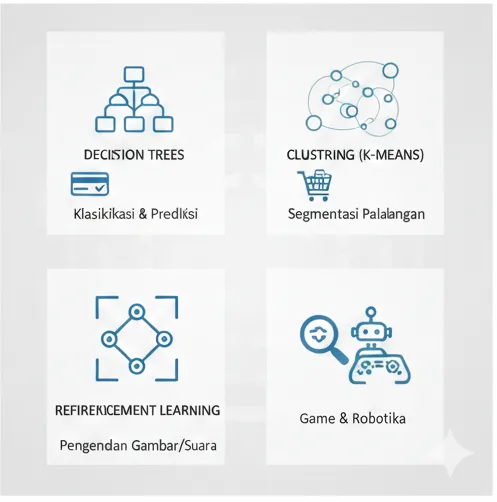
Different model families learn in different ways. A Decision Tree divides data through branching conditions. A neural network passes information through layers of weighted calculations. The right method depends on the problem, data, evaluation target, and operational constraints. Our overview of popular AI algorithms explains ten common options.
4. Running Inference
Once a model has been trained and evaluated, it can process data it has not seen before. A fraud model may estimate the risk of a transaction. A recommendation model may rank a list of products. A generative language model predicts tokens repeatedly to construct a response.
The prediction is based on patterns the model learned, not on certainty. If the new input differs substantially from the training data, performance can decline.
5. Turning Model Output into a Useful Result
Raw model output often needs post-processing. An application may convert a probability into a label, combine a score with a business rule, or format generated content for the user interface.
Some models return a confidence score. This represents the model’s estimated confidence under its own assumptions; it is not a guarantee that the prediction is correct. High-impact decisions still require appropriate review and accountability.
Example: How AI Recognises an Image
An image classifier turns pixels into numbers, extracts visual patterns, and estimates which label best matches those patterns. A simplified workflow for identifying a cat looks like this:
- The image is received. Pixel colour and position values become the numerical input.
- Visual features are processed. Early layers respond to simple patterns such as edges, while later layers combine them into more complex shapes.
- Class probabilities are calculated. The model compares the image representation with patterns formed during training.
- The result is displayed. The application returns a label such as “cat” with an associated confidence score.
The interface makes this sequence appear immediate, but the result depends on earlier choices about labels, training examples, model architecture, and evaluation.
How Generative AI Produces a Response
A generative language model creates text by repeatedly predicting a suitable next token from the context it has received. Tokens can be whole words, parts of words, punctuation, or other text units.
The model evaluates possible continuations, selects one according to its generation settings, adds it to the context, and repeats the process. This can produce coherent writing without verifying every statement against a factual source. A plausible answer can therefore still be wrong.
Applications can improve reliability by supplying relevant documents, adding tools, applying validation rules, and asking people to review sensitive outputs. These measures shape how the model is used; they do not make its predictions infallible.
What Affects AI Performance?
AI performance depends on the data, model choice, evaluation process, and conditions in which the system is used. Key factors include:
- Data quality. Incorrect, biased, or unrepresentative examples lead to unreliable patterns.
- Model fit. A model can be too simple to capture the task or so flexible that it memorises training data.
- Evaluation design. Testing on separate, representative data provides a more realistic measure of performance.
- Input quality. Ambiguous questions, blurry images, and unfamiliar cases make prediction harder.
- Operational change. Customer behaviour, language, markets, and other real-world conditions can shift after deployment.
Monitoring matters because a model that performed well during development may degrade as its environment changes.
Conclusion
AI turns input into output through data preparation, model training, inference, and application-level processing. Training establishes the model’s parameters, while inference applies them to new data.
Understanding this workflow makes AI easier to assess realistically. Its output can be useful at scale, but the result remains limited by the evidence it learned from, the model design, and the context in which it is used.
Frequently Asked Questions
Does AI learn by itself?
AI can update its parameters during a designed training process, but people still define the objective, data, algorithm, and evaluation. Many deployed models remain unchanged until they are deliberately retrained.
Why does AI make mistakes?
AI can fail because its data is incomplete, the input is ambiguous, conditions have changed, or the model selects a statistically plausible but incorrect result. A high confidence score does not remove that possibility.