What Is the Difference Between AI, Machine Learning, and Deep Learning?
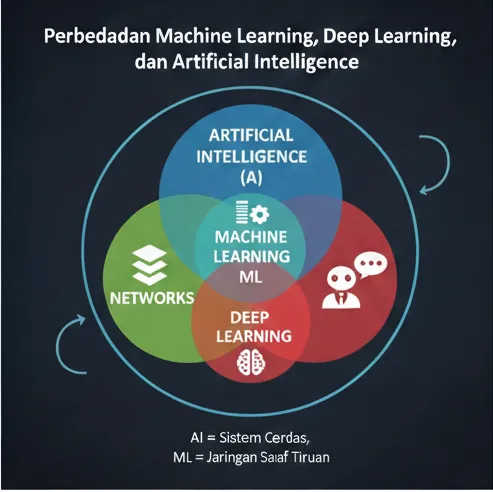
Artificial intelligence is the broad field, machine learning is a subset of AI, and deep learning is a subset of machine learning. In short: Deep Learning ⊂ Machine Learning ⊂ Artificial Intelligence.
The terms are related, but they are not interchangeable. They describe different levels of scope and different ways of building a system that can recognise patterns, make predictions, or support decisions.
| Area | Artificial Intelligence | Machine Learning | Deep Learning |
|---|---|---|---|
| Scope | The full discipline | A subset of AI | A subset of ML |
| Main approach | Rules, search, or learning | Learning patterns from data | Learning with multilayer neural networks |
| Data needs | Depends on the method | Usually requires training data | Often requires more data and compute |
| Feature handling | May use explicit rules | Features are often prepared by people | Many features are learned automatically |
| Example | Rule-based expert system | Churn prediction | Image recognition |
What Is Artificial Intelligence?
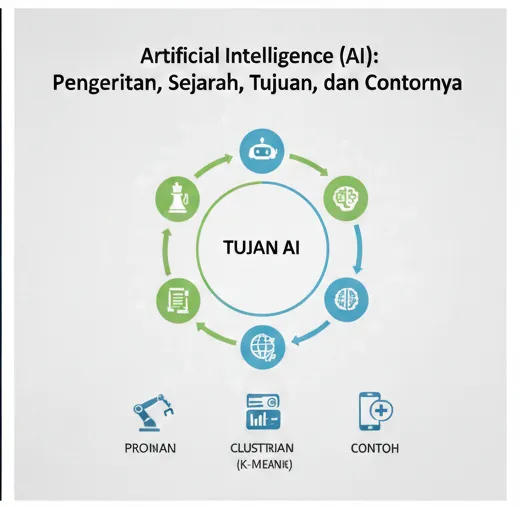
Artificial intelligence is the discipline of creating machines that can perform tasks associated with human intelligence. It includes reasoning, planning, pattern recognition, language processing, and decision-making.
An AI system does not have to learn from data. A rule-based expert system can follow a structured set of if–then conditions to produce a recommendation. Search algorithms used in games and planning can also fall within AI without being machine learning models.
Most AI in use today is narrow AI: a system designed for a specific task or limited domain. Read what artificial intelligence is for a wider introduction to its history, capabilities, and limitations.
What Is Machine Learning?
Machine learning is an AI approach in which a model learns useful patterns from data instead of having every decision rule written by hand. The model is trained on examples, evaluated against a target, and adjusted to improve its predictions.
Machine learning is usually grouped into three learning settings:
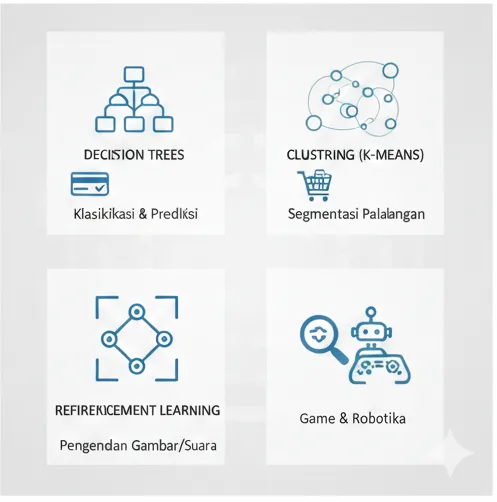
- Supervised learning. The model learns from labelled examples, such as emails marked as spam or legitimate.
- Unsupervised learning. The model searches for structure in unlabelled data, such as customer groups with similar behaviour.
- Reinforcement learning. An agent learns from actions, environmental states, and rewards received over time.
Common methods include regression, Decision Trees, Random Forests, Support Vector Machines, and K-Means. Their effectiveness depends on relevant data and sound evaluation—not simply on having the largest possible dataset.
What Is Deep Learning?
Deep learning is a machine learning technique that uses neural networks with many layers to learn complex representations of data. Each layer transforms the information before passing it to the next.
In image recognition, early layers may respond to edges and colour changes. Later layers combine those signals into textures, shapes, and object-level patterns. This ability reduces the amount of manual feature engineering required for many image, audio, and language tasks.
Common deep learning architectures include:
- Convolutional Neural Networks, widely associated with image processing.
- Recurrent Neural Networks, designed for sequential data, although newer architectures now handle many of the same tasks.
- Transformers, which underpin many modern language and generative models.
- Generative Adversarial Networks, which train competing networks to generate new data.
Deep learning often needs more computing power and training data than traditional ML. The actual requirement depends on the model size, task, and whether an existing pretrained model can be adapted.
The Key Differences Explained
Scope
AI describes the overall goal and field; ML and deep learning describe increasingly specific approaches within it. Calling every AI system “deep learning” ignores rule-based and classical machine learning methods that may be better suited to the task.
How Rules Are Created
Rule-based AI follows logic written by people, while machine learning estimates parameters from data. Deep learning also learns from data, but it does so through layered neural networks that can form complex internal representations.
Data and Computing Requirements
Resource needs depend on the complexity of the model and problem, not just the label attached to the technology. A rule-based system can be lightweight. Many classical ML models train effectively on CPUs, while large deep learning models commonly use GPUs or other accelerators.
Interpretability
Explicit rules and simpler statistical models are often easier to inspect than large neural networks. A Decision Tree can expose its branches directly, whereas a deep model may require additional interpretation methods. Explainability requirements should be considered before selecting a model.
Best-Fit Data
Classical ML is often strong on structured tables, while deep learning is widely used for complex unstructured data. Images, audio, and natural language contain patterns that neural networks can learn with less manual feature design. This is a tendency, not an absolute rule.
Practical Examples
A single product may use AI rules, machine learning, and deep learning in different components. For example:
- Rule-based AI routes a support request according to explicit operational conditions.
- Machine learning predicts which customers are likely to cancel based on historical account data.
- Deep learning identifies objects in an uploaded image or generates text from a prompt.
A navigation product might use rules for hard restrictions, ML for travel-time estimates, and deep learning for visual perception. The right label applies to the method used in each component, not necessarily to the product as a whole.
When Should You Use Each Approach?
Choose the simplest method that can meet the performance, risk, and operational requirements of the problem. A practical starting point is:
- Use explicit rules when the conditions are stable, easy to define, and must be audited directly.
- Use classical machine learning when structured data is available and the pattern is too complex to encode one rule at a time.
- Use deep learning when the problem involves complex image, audio, or text patterns and sufficient data and computing resources are available.
Deep learning is not automatically the best choice. A simpler model may be faster, less expensive, easier to explain, and just as accurate for a particular dataset. Candidates should be compared on representative test data using metrics tied to the actual cost of errors.
Conclusion
The difference between AI, machine learning, and deep learning is mainly one of scope and method. AI is the broad field, ML learns patterns from data, and deep learning uses multilayer neural networks as a specific learning technique.
Knowing the hierarchy makes it easier to describe a project accurately and select an appropriate approach. For a closer look at individual methods, continue with ten popular AI algorithms and when to use them.
Frequently Asked Questions
Does every AI system use machine learning?
No. AI can use programmed rules, search, planning, and other techniques without learning from data. Machine learning is one important branch of the wider field.
Is deep learning always more accurate?
No. Performance depends on the problem, data quality, model configuration, and evaluation method. Classical ML can be a better fit for smaller or structured datasets.