What Is Generative AI?
Generative AI is a category of artificial intelligence that creates new content from patterns learned during training. Its output can include text, images, audio, video, software code, structured data, or a combination of formats.
The system does not retrieve one finished answer from storage. It calculates a new output from the prompt, available context, model parameters, and any tools or sources it is allowed to use.
The NIST Generative AI Profile describes generative AI as models that emulate the structure and characteristics of input data to produce synthetic content. That definition covers much more than conversational chatbots.
- Generative AI creates content rather than only classifying or predicting an outcome.
- Large language models are used for language tasks, while other model families support images, audio, and video.
- The output is influenced by the prompt, context, model, and connected tools.
- Generated content can be useful without being factual, original, safe, or ready to publish.
How Is Generative AI Different from Traditional AI?
Traditional predictive AI usually selects a label, score, forecast, or recommendation; generative AI produces new material. A fraud model might estimate the probability that a transaction is suspicious. A generative model might explain the factors behind that score in plain language.
The distinction is about the output, not whether one system is more advanced. Many products combine both. An application may predict user intent, retrieve relevant information, and then use a generative model to present the result.
| System objective | Typical output |
|---|---|
| Classification | A category or label |
| Prediction | A probability or numerical estimate |
| Recommendation | A ranked list |
| Generative AI | Newly generated text, media, code, or data |
How Does Generative AI Work?
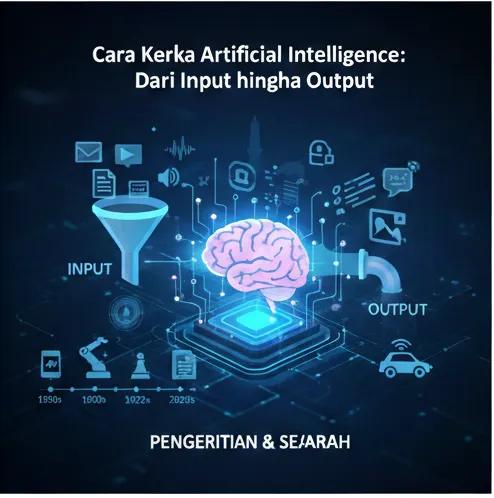
The exact architecture varies, but most generative systems follow a common lifecycle.
Training
Data is collected, prepared, and converted into a form the model can process. During training, the model adjusts internal parameters to capture statistical relationships in that data. It does not store a neat database of rules or facts.
Prompt and context
At use time, the application provides an instruction and supporting context. Context might include conversation history, uploaded files, retrieved documents, system rules, or information returned by a tool.
Inference
The trained model generates an output step by step. A language model predicts tokens, while an image model may progressively construct a visual representation. This application of a trained model is called inference.
Post-processing and review
The application may filter, format, cite, or test the output before showing it. Human review is still necessary when accuracy, originality, safety, or accountability matters.
See how AI works for a broader explanation of data preparation, training, inference, and monitoring.
Technologies Behind Generative AI
Different content types call for different model architectures:
- Large language models, or LLMs, generate and transform text, code, and structured language.
- Diffusion models are widely used to generate and edit images, audio, and video.
- Generative adversarial networks, or GANs, use competing networks to produce realistic synthetic data.
- Multimodal models process and generate more than one type of input or output.
A product name does not identify a single permanent model. Providers routinely change model versions, tools, interfaces, and routing systems behind the application.
The relationship between tokens, context, retrieval, and evaluation is developed in how generative AI and LLMs work.
Common Uses of Generative AI
Generative AI is most useful as a drafting, transformation, and exploration tool. Practical uses include:
- Drafting emails, reports, briefs, and outlines.
- Summarising or comparing documents.
- Translating and adapting content for a different audience.
- Generating, explaining, and debugging code.
- Creating illustrations, mock-ups, audio, or video.
- Producing synthetic data for testing or simulation.
- Turning analysis into a readable narrative.
- Creating variations for review rather than publishing one output unchanged.
The value comes from fitting the model into a defined workflow. A vague request may produce polished but generic output, while clear context and evaluation criteria make the result easier to use.
Benefits and Risks
Generative AI can reduce the time required to produce a first draft, explore alternatives, simplify complex material, and make specialist tools accessible through natural language.
Those benefits come with material risks:
| Risk | What it can look like |
|---|---|
| Hallucination | A fabricated fact, source, quotation, or calculation |
| Bias | Stereotyped or uneven treatment inherited from data and design |
| Privacy exposure | Sensitive information included in prompts, files, or logs |
| Copyright concerns | Output that resembles protected material or lacks clear provenance |
| Prompt injection | Untrusted content attempting to redirect the system |
| Automation bias | A person accepting a confident response without checking it |
NIST recommends managing these risks across the AI lifecycle rather than checking only the final output. Governance, context mapping, measurement, and incident response all matter.
Generative AI, Narrow AI, and Agentic AI
These terms describe different dimensions:
- Narrow AI describes the limited scope of current systems.
- Generative AI describes the ability to create content.
- Agentic AI describes a system that can plan and take actions towards a goal.
A generative model can be one component inside an agentic system. It can also be used alone to answer a prompt without taking any action beyond producing the response.
Frequently Asked Questions
Is generative AI the same as ChatGPT?
No. ChatGPT is one product that uses generative AI. The category also includes many other text, image, audio, video, and code systems.
Do all generative AI systems use LLMs?
No. LLMs specialise in language. Image, audio, and video generation may use diffusion models or other architectures.
Why does generative AI make factual errors?
The model generates a plausible output from patterns; it is not a guaranteed factual database. Missing context, weak sources, ambiguous prompts, and model limitations can all produce errors. See why large language models hallucinate for the distinct roles of factuality, groundedness, retrieval, and validation.
Can generated content be published immediately?
It should be reviewed first. Check facts, sources, originality, permissions, tone, and whether the result meets the real objective.
Conclusion
Generative AI creates new text, media, code, or structured output from learned patterns and supplied context. It can accelerate drafting and analysis, but fluency should never be confused with accuracy.
The most reliable use combines a clear task, relevant context, appropriate tools, and human review proportionate to the consequences of an error.