What Is Artificial Intelligence?
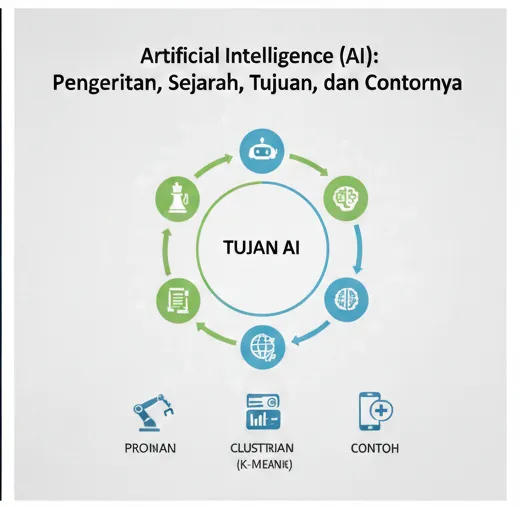
Artificial intelligence, or AI, is a field of computer science focused on building machines that can perform tasks that normally require human intelligence. These tasks include recognizing patterns, understanding language, making predictions, recommending actions, and generating content.
The word “intelligence” can be misleading. Most AI systems do not think or understand the world as people do. They use rules, statistical models, or learned patterns to complete a defined task within a specific context.
Spam filters, navigation apps, recommendation engines, image recognition tools, and generative AI all fall under the broad AI category. They share a goal—turning input into a useful result—but rely on different data and methods.
How Does AI Work?
AI works by processing input through an algorithm or trained model and producing an output such as a classification, forecast, recommendation, or response.
A typical workflow has four stages:
- The system receives data. The input might be text, an image, audio, video, or structured numbers.
- The data is prepared. Software cleans and converts the input into a numerical representation the model can process.
- An algorithm processes it. The system applies programmed rules or parameters learned during training.
- The application returns a result. It may label an image, rank products, detect an anomaly, or produce new content.
Models based on machine learning are trained on examples before they are used. Applying a trained model to new input is called inference. Our guide to how AI works explains the full process in more detail.
A Brief History of AI
AI developed through several waves of research shaped by new ideas, larger datasets, and more capable computers. Important milestones include:
- 1950 — the question of machine intelligence. Alan Turing published Computing Machinery and Intelligence and proposed an imitation-based test of machine behaviour.
- 1956 — AI becomes a field. The Dartmouth workshop helped establish artificial intelligence as a distinct area of research, with John McCarthy credited for the term.
- 1960s and 1970s — early AI programs. Researchers built systems for games, theorem proving, and basic language processing, although computing limits prevented many early ambitions from being realised.
- 1980s — expert systems. Rule-based software was adopted in specialised domains to reproduce parts of an expert decision process.
- 1990s and 2000s — machine learning grows. More work shifted from manually coding every rule to training models on data.
- 2010s onward — deep learning and generative AI. Improvements in hardware, data availability, and neural network methods expanded image recognition, language processing, and content generation.
This history matters because AI progress never comes from an algorithm alone. Data quality, computing resources, evaluation methods, and product design all shape what a system can do.
The Main Types of Artificial Intelligence
AI is commonly discussed as narrow AI or artificial general intelligence based on the range of tasks it can perform.
Narrow AI
Narrow AI is designed for a particular task or bounded set of tasks. Search ranking, fraud detection, voice recognition, and large language models are all examples. A system may perform exceptionally well in its intended setting without being able to transfer that ability to an unrelated problem.
Artificial General Intelligence
Artificial general intelligence, or AGI, describes a hypothetical machine that could learn and perform intellectual tasks across domains with broad, human-like flexibility. It remains a research goal rather than a technology available for ordinary use.
Generative AI is not a third level of intelligence. It is a category of systems that creates text, images, audio, video, or code based on patterns learned from training data.
What Can AI Be Used For?
AI is most useful when a task involves repeated decisions, large amounts of data, or patterns that are difficult to capture with fixed rules. Common capabilities include:
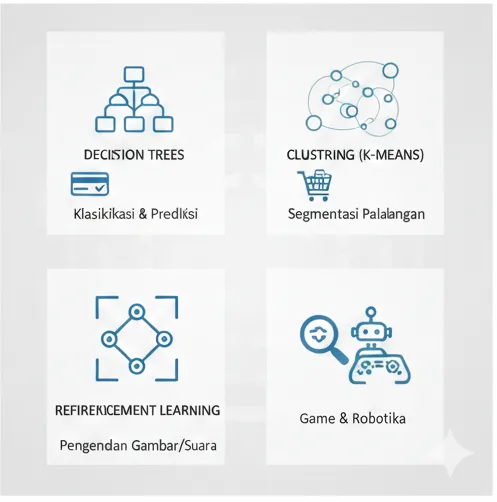
- Classification. Assigning a label, such as spam or legitimate, to new input.
- Prediction. Estimating a future value, event, or level of risk from historical data.
- Recommendation. Ranking products, content, or actions according to expected relevance.
- Pattern detection. Finding unusual transactions, equipment behaviour, or changes in demand.
- Content generation. Producing a draft, image, summary, transcript, or piece of code from a prompt.
- Process support. Sorting documents, routing requests, and extracting information from repetitive inputs.
Examples of AI in Everyday Life
Many digital products use AI behind the scenes even when they are not marketed as AI tools. Familiar examples include:
- Search engines that interpret queries and rank relevant results.
- Streaming and shopping platforms that personalise recommendations from user behaviour.
- Navigation apps that estimate travel time and select routes from traffic conditions.
- Banks and payment services that flag transactions with unusual patterns.
- Email platforms that filter spam and suggest short replies.
- Accessibility tools that convert speech to text, read text aloud, or describe images.
- Medical imaging software that helps qualified professionals review scans and identify areas requiring attention.
In high-stakes settings, an AI output should support—not replace—the judgement of the accountable professional.
Benefits and Limitations of AI
AI can process information consistently at scale, but its output is constrained by its data, design, and operating context.
Potential benefits include faster analysis, more consistent handling of repetitive tasks, personalised experiences, and earlier detection of patterns. These advantages only matter when the output is tied to a clear need and evaluated against a meaningful standard.
The limitations are equally important. Training data can carry historical bias. Models may fail on unfamiliar inputs, expose sensitive information if systems are poorly designed, or produce confident statements that are factually wrong. Complex models can also be difficult to explain.
Human review, data governance, testing, and ongoing monitoring are therefore part of responsible AI use—not optional steps added after deployment.
Conclusion
Artificial intelligence is the broad discipline of building machines that can perform tasks associated with human intelligence. Some systems follow explicit rules, while others learn patterns from data through machine learning and deep learning.
AI is already embedded in search, recommendations, navigation, security, accessibility, and content tools. Understanding both its capabilities and its limits makes it easier to judge where the technology is genuinely useful.
Frequently Asked Questions
Is AI the same as machine learning?
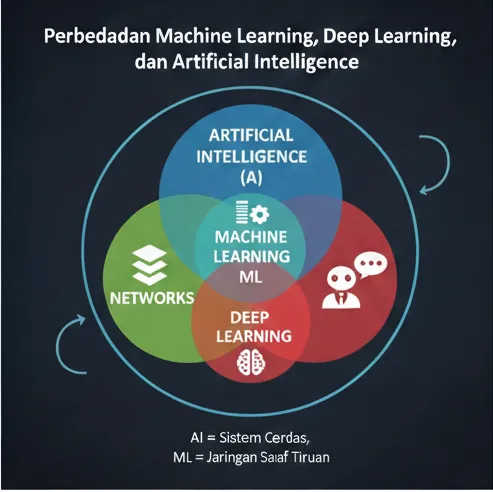
No. Machine learning is one approach within the wider field of AI. Rule-based expert systems can be considered AI without learning from data. See AI vs machine learning vs deep learning for a detailed comparison.
Can AI think like a human?
AI systems in everyday use do not think or understand the world in the same way people do. They calculate outputs from rules and statistical patterns within the limits of their design and training.