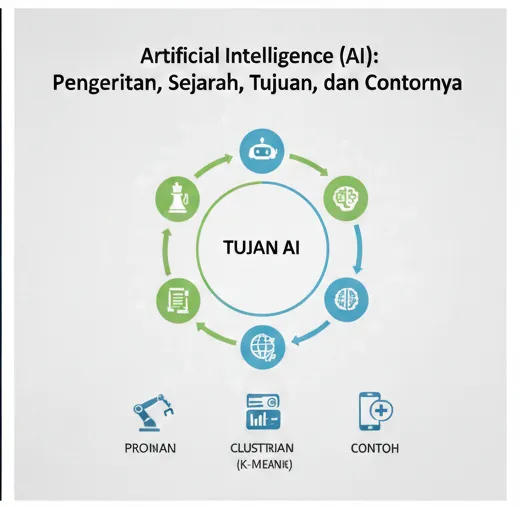
What Is Artificial Intelligence? Definition and Examples
Learn what artificial intelligence is, how it works, its main types, key milestones, everyday applications, benefits, and limitations.
Start with what artificial intelligence means, how a model turns input into output, and where machine learning and deep learning fit. This cluster builds the vocabulary needed before exploring generative AI, agents, and analytics applications.
12 articles
Four steps through the definition, mechanism, hierarchy, and methods behind AI systems.
what artificial intelligence means and where it falls short — Begin with the definition, a short history, everyday examples, and current limitations.
how AI moves from input to output — Follow the process through data preparation, training, inference, and post-processing.
the difference between AI, machine learning, and deep learning — Place the three terms in the correct hierarchy and understand when each applies.
AI algorithms and the problems they solve — Compare common methods by data type, objective, trade-off, and evaluation target.
Learn what artificial intelligence is, how it works, its main types, key milestones, everyday applications, benefits, and limitations.
Start with the definition, operating process, relationship to machine learning, and common algorithms.
Understand how AI works through data preparation, model training, inference, and output, with clear examples and practical limitations.
Compare AI, machine learning, and deep learning by scope, methods, data requirements, computing needs, and practical use cases.
Explore 10 popular AI and machine learning algorithms, how they work, common use cases, trade-offs, and a practical selection process.
Distinguish systems by the scope of their abilities, the output they produce, and how they pursue a goal.
Narrow AI is designed for a specific task or bounded set of tasks. Learn how it works, where it appears, and how it differs from AGI.
Generative AI creates text, images, audio, video, and code from learned patterns. Learn how it works, where it is used, and what can go wrong.
Agentic AI can plan and take actions towards a goal. Learn how it works, what components it needs, and how it differs from traditional AI.
Understand popular AI products through concise guides to their purpose, features, access, and limits.
Gemini is Google's AI assistant for writing, research, file analysis, images, and everyday tasks. Learn its main features and how to use it.
Meta AI is an assistant available across WhatsApp, Instagram, Facebook, Messenger, the web, and its own app. Learn what it does and how to use it.
Claude is Anthropic's AI assistant for writing, document analysis, research, coding, and data work. Learn its main features and how to use it.
Perplexity is an AI search engine that summarises information and links to its sources. Learn how it works, what it offers, and how to verify answers.
Grok is xAI's assistant for questions, web and X search, content, images, and coding. Learn its features, access, limitations, and privacy controls.
Explore how generative models produce responses, retrieve external context, and still fail. The focus is technical enough to be useful without turning into model-development documentation.
AI agents do more than generate text. This cluster explains how models use tools, retain context, complete steps, and operate within limits that people can inspect and control.
This cluster examines how AI connects data, detects changes, and builds analytical context. The emphasis is not automation promises, but decision material that remains open to verification.