What Is an AI Algorithm?
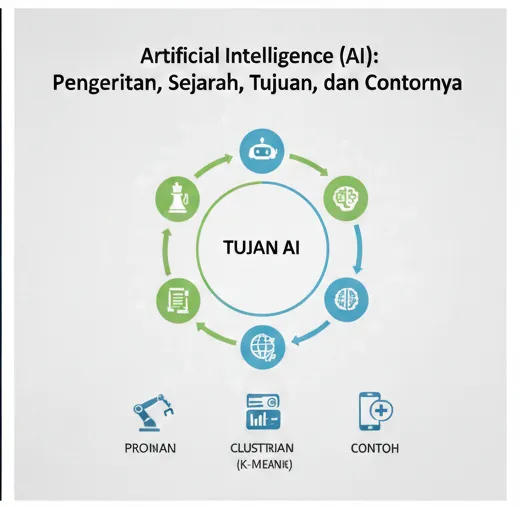
An AI algorithm is a computational procedure used to process data, identify patterns, and produce a prediction or decision. Each algorithm makes different assumptions and fits a different type of problem.
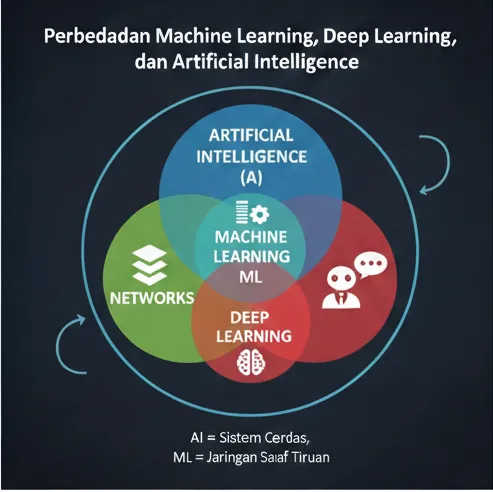
“AI algorithm” is often used as shorthand for a machine learning algorithm, but the terms are not identical. AI also includes rules, search, planning, and optimisation methods that do not learn from training data. Our comparison of AI, machine learning, and deep learning explains the hierarchy.
The following ten algorithms are common starting points in practical machine learning.
1. Linear Regression
Linear Regression models the relationship between input variables and a continuous numerical target. It finds a line or plane that minimises the difference between predicted and observed values.
It is useful as a baseline for sales forecasts, energy demand, or property valuation when relationships are reasonably linear. The coefficients are easy to inspect, but more complex patterns require feature transformations or a different model.
2. Logistic Regression
Logistic Regression estimates the probability that an example belongs to a particular class. Despite its name, it is mainly used for classification, especially binary outcomes.
Typical applications include churn prediction, transaction risk, and email response modelling. Its coefficients can show how a feature changes the estimated odds, making it easier to explain than many more complex classifiers.
3. Decision Tree
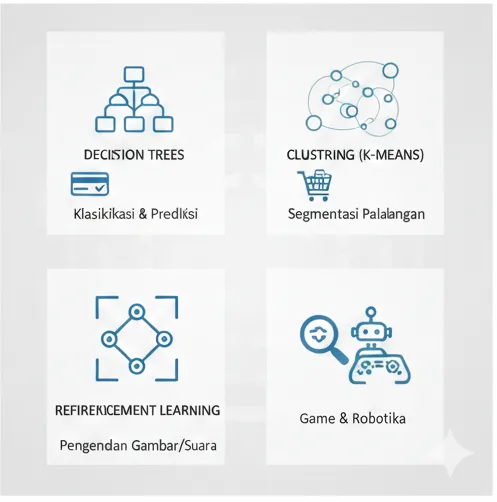
A Decision Tree predicts an outcome through a sequence of branching conditions. Each node tests a feature, and each branch leads to another test or a final result.
Decision Trees support classification and regression and can be visualised directly. They suit projects that need a readable decision path, although a very deep tree may overfit its training data and perform poorly on new examples.
4. Random Forest
A Random Forest combines predictions from many Decision Trees trained on varied samples and feature subsets. Classification usually uses a vote, while regression combines numerical predictions.
This approach is often more stable than a single tree and works well on many tabular datasets. It is used for risk prediction, customer classification, and operational forecasting. The combined model is less transparent than one Decision Tree.
5. Gradient Boosting
Gradient Boosting builds models sequentially, with each new model focusing on errors left by the previous ones. Well-known implementations include XGBoost, LightGBM, and CatBoost.
It is often effective for structured business data, including demand forecasts, credit risk, and conversion prediction. Careful validation and parameter tuning are important because an overly aggressive configuration can overfit and add unnecessary training cost.
6. Support Vector Machine
A Support Vector Machine, or SVM, finds a boundary that separates classes with the widest possible margin. The training points closest to that boundary—the support vectors—determine its position.
Kernel functions allow SVMs to model nonlinear boundaries. They are used for text, image, and biological classification, particularly on small to medium datasets with well-prepared features. Training can become expensive as the dataset grows.
7. K-Nearest Neighbours
K-Nearest Neighbours, or KNN, predicts an outcome from the closest stored examples. Classification uses a neighbour vote, while regression can use their average value.
KNN is simple and has no conventional model-training stage, but prediction can become slow on large datasets. Its performance is also sensitive to feature scaling, the number of neighbours, and the chosen distance measure.
8. Naive Bayes
Naive Bayes applies Bayes’ theorem to estimate class probabilities from observed features. It assumes features are conditionally independent within each class—an assumption that is rarely exact but often useful.
The method trains and predicts quickly, especially for text classification. Common uses include spam filtering, basic sentiment analysis, and routing support tickets according to their content.
9. K-Means Clustering
K-Means groups unlabelled data into a specified number of clusters based on distance from each cluster centre. It repeatedly assigns points and updates the centres until the solution stabilises or reaches an iteration limit.
It can support customer segmentation, document grouping, and exploratory analysis. The user must choose the number of clusters, and the result can be sensitive to starting positions, feature scale, and outliers.
10. Neural Network
A neural network processes data through layers of weighted computational units and activation functions. During training, the weights are updated to reduce prediction error.
Networks with many layers form the basis of deep learning. Different architectures are used for images, language, audio, and generative applications. They can learn complex patterns but often require more data, computing power, tuning, and monitoring than simpler models.
Where Does PCA Fit?
Principal Component Analysis, or PCA, is a dimensionality-reduction technique rather than a primary prediction model. It transforms correlated features into a smaller set of components that retain as much variation as possible.
PCA can simplify inputs, reduce noise, or make high-dimensional data easier to visualise. It is commonly used before another algorithm rather than as the final classifier or regressor.
How to Choose the Right Algorithm
Choose an algorithm from the problem, data, cost of errors, and deployment constraints—not from popularity. A practical selection process is:
- Define the output. Use classification for categories, regression for numbers, and clustering to explore groups without labels.
- Inspect the data. Review sample size, feature types, missing values, class imbalance, and likely changes over time.
- Establish a simple baseline. Logistic Regression or a Decision Tree can reveal whether added complexity provides meaningful value.
- Select relevant metrics. Accuracy may hide important errors; consider precision, recall, F1 score, or a suitable regression error measure.
- Test on separate data. Evaluation data must remain outside training so that generalisation can be measured honestly.
- Account for operations. Prediction speed, computing cost, auditability, retraining, and monitoring all affect the final choice.
There is no universally best algorithm. Teams normally compare several candidates under the same evaluation conditions and choose the model that provides the right balance of performance, clarity, and operational cost.
Conclusion
Popular AI and machine learning algorithms solve different classification, regression, clustering, and representation problems. Linear models provide interpretable baselines, tree ensembles are strong on many tabular datasets, K-Means finds groups, and neural networks handle more complex patterns.
Model selection should begin with the problem rather than the most fashionable method. Even after an algorithm is chosen, data quality, validation, and ongoing monitoring determine whether it remains useful in practice.
Frequently Asked Questions
Which AI algorithm is best for beginners?
Linear Regression, Logistic Regression, and Decision Trees are useful starting points because their behaviour is relatively easy to inspect. The right first algorithm still depends on whether the task involves a number, a category, or an unlabelled dataset.
Are neural networks always better than traditional machine learning?
No. Neural networks are valuable for complex images, audio, and language, but simpler models may perform as well or better on smaller structured datasets. They can also be faster to train and easier to explain.